
 Agriculture
 Food Processing
 Construction and Industry
 Fishery
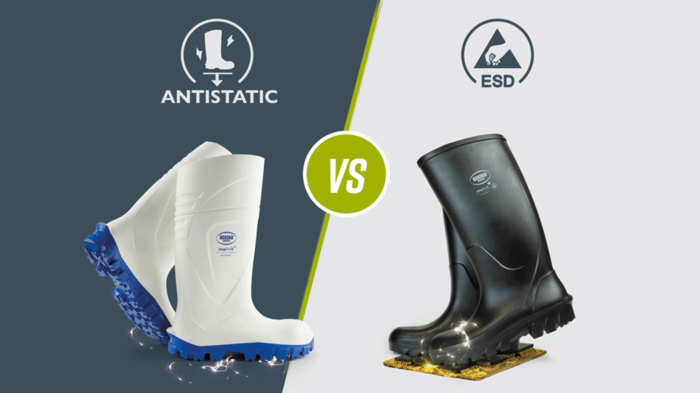
In industrial environments, static electricity is often an underestimated risk. However, even a small electrostatic discharge can have major consequences: from damage to sensitive equipment and process interruptions to expensive repairs. That is why antistatic and ESD safety shoes and safety boots play a crucial role. But what is the difference?
Antistatic: basic protection against static electricity
Antistatic protection prevents static electricity from accumulating in the wearer's body. Antistatic safety boots allow electrical charges to flow to the ground in a controlled manner, reducing the risk of sudden discharges. Antistatic safety footwear helps to prevent dangerous sparks and potential fire or explosion risks.
This type of footwear offers protection against static electricity with an electrical resistance between 0.1 MegaOhm and 1000 MegaOhm.
ESD: improves personal safety and protects your products and machinery
ESD stands for Electrostatic Dissipative: a material that offers protection against Electrostatic Discharge. ESD safety boots go one step further than antistatic safety boots. They have a lower and more precisely controlled electrical resistance, which means that electrostatic charge is dissipated much more efficiently and consistently.
The difference is therefore not whether the charge is dissipated, but how quickly and controlled this happens. In environments where even minimal discharges can cause damage, such as an Electrostatic Discharge Protected Area (EPA), it is essential.
This type of footwear offers high protection against static electricity with an electrical resistance between 0.1 MegaOhm and 100 MegaOhm.
Why is ESD so important?
.An Electrostatic Discharge Protected Area (EPA) is a specially designed and demarcated zone where everything is kept grounded. In such sensitive environments, even a barely noticeable discharge can have major consequences, which is why choosing for ESD protection in your boots is so important. This explains why ESD has become one of the top five cost items in modern, automated factories in recent years.
- Prevents the build-up and discharge of static electricity
- Prevents (dangerous) sparks
- Protects sensitive electronic devices from damage
- Increases the safety and integrity of the product in EPA risk zones
This is essential for:
- Sensitive electronic devices
- Powder coatings
- Data centres
- Working on silos
- ...
Be safe thanks to Bekina Boots
All safety boots from Bekina Boots are antistatic. This already provides the necessary protection against static electricity, but with the latest StepliteS FlexGrip (S5) and StepliteS CleanGrip (S4) models, Bekina Boots goes even one step further. These boots are not only antistatic, but also ESD-safe, making them suitable for the most demanding working environments, including Electrostatic Discharge Protected Areas. Antistatic footwear is sufficient in many situations, but in environments where precision, safety and the highest level of product protection are paramount, boots with a ESD-protection make the difference. By choosing the right protection for your feet, you reduce risks and increase the safety of yourself, your products, your machines and your business!
Any questions? Please feel free to contact us at info@bekina-boots.com.




 Leisure